
The mining of bauxite, an essential ore for aluminum, is concentrated in tropical and subtropical regions and has a major climatic and environmental impact: it destroys ecosystems through open-pit mining (deforestation, erosion, water and soil pollution), generates greenhouse gas emissions (fossil fuels for transport/drying) and poses social challenges (displacement of populations). The climatic context is twofold: bauxites are formed in hot, humid climates, but their intense extraction in these fragile zones exacerbates the degradation associated with these same climates (rainy seasons, mudflows). The aim of this study is to analyze the impact of climate change on microclimates linked to mining activities in the Boke region of Guinea. Using meteorological data recorded between 2010 and 2023, the research assesses the interannual variability of key climate parameters – temperature, relative humidity, atmospheric pressure, solar radiation and wind speed – using a centred and reduced variable approach and multivariate correlation analysis (Principal component analysis (PCA)). The results reveal a significant warming trend, with an increase in the average annual temperature of approximately 1.3°C, accompanied by a increase from 73% to 79-80% in relative humidity and a slight decrease in atmospheric pressure. Solar radiation and wind speed show irregular seasonal variations, but tend to intensify during the dry season, reflecting increased continentality. The correlation analysis shows a strong negative correlation between temperature and humidity (r = –0.86) and a positive correlation between temperature and solar radiation (r = +0.78), indicating increased thermal imbalance and greater atmospheric dryness. Furthermore, the prevailing wind direction has shifted from north-east (2010–2014) to south-west (2020–2023), reflecting a growing maritime influence. These climatic fluctuations coincide with the rapid expansion of mining activities, deforestation and soil degradation, leading to the emergence of localised microclimatic anomalies. These results highlight the need for integrated environmental management, combining continuous meteorological monitoring, reforestation and sustainable mining practices in order to mitigate local climate disturbances.
| Published in | International Journal of Environmental Monitoring and Analysis (Volume 14, Issue 1) |
| DOI | 10.11648/j.ijema.20261401.15 |
| Page(s) | 44-51 |
| Creative Commons |
This is an Open Access article, distributed under the terms of the Creative Commons Attribution 4.0 International License (http://creativecommons.org/licenses/by/4.0/), which permits unrestricted use, distribution and reproduction in any medium or format, provided the original work is properly cited. |
| Copyright |
Copyright © The Author(s), 2026. Published by Science Publishing Group |
Climate Variability, Microclimate, Boke Region, Mining Impact, Meteorological Parameters, Guinea
Year | Minimum temperature (°C) | Maximum temperature (°C) | Relative humidity (%) |
|---|---|---|---|
2010 | 22.2 | 34.0 | 73 |
2011 | 20.0 | 34.2 | 71 |
2012 | 21.0 | 33.3 | 72 |
2013 | 22.2 | 33.6 | 73 |
2014 | 21.4 | 34.0 | 73 |
2015 | 20.0 | 35.0 | 74 |
2016 | 21.8 | 34.2 | 78 |
2017 | 22.1 | 34.0 | 76 |
2018 | 21.9 | 33.2 | 79 |
2019 | 22.0 | 33.2 | 80 |
2020 | 22.0 | 32.5 | 80 |
2021 | 21.5 | 33.2 | 79 |
Month | Min T (°C) | Max T (°C) | Avg T (°C) | Precipitations (mm) |
|---|---|---|---|---|
January | 18.5 | 33.9 | 26.2 | 0.0 |
February | 20.8 | 34.4 | 27.6 | 0.0 |
March | 21.6 | 37.9 | 29.8 | 0.0 |
April | 22.2 | 36.6 | 29.4 | 0.0 |
May | 21.9 | 34.3 | 28.1 | 7.0 |
June | 22.9 | 31.9 | 27.4 | 171.5 |
July | 21.5 | 29.9 | 25.7 | 367.5 |
August | 21.9 | 29.1 | 25.5 | 712.5 |
September | 22.0 | 30.6 | 26.3 | 463.0 |
October | 22.4 | 32.1 | 27.3 | 437.0 |
November | 22.4 | 33.2 | 27.8 | 87.0 |
December | 19.6 | 34.1 | 26.9 | 0.0 |
Month | Min Station pressure (hPa) | Max Station pressure (hPa) | Minimum sea pressure (hPa) | Maximum sea pressure (hPa) |
|---|---|---|---|---|
January | 1004 | 1008 | 1073 | 1077 |
February | 1008 | 1010 | 1077 | 1079 |
March | 1004 | 1007 | 1073 | 1076 |
April | 1006 | 1010 | 1075 | 1079 |
May | 1005 | 1007 | 1074 | 1076 |
June | 1010 | 1012 | 1079 | 1081 |
July | 1008 | 1011 | 1077 | 1080 |
August | 1006 | 1010 | 1075 | 1079 |
September | 1006 | 1008 | 1075 | 1077 |
October | 1005 | 1007 | 1074 | 1076 |
November | 1004 | 1006 | 1073 | 1075 |
December | 1003 | 1005 | 1072 | 107 |
Year | Speed (m/s) | Dominant direction |
|---|---|---|
2010 | 2.1 | North-East |
2011 | 2.3 | North-East |
2012 | 2.2 | East |
2013 | 2.4 | East |
2014 | 2.5 | East |
2015 | 2.3 | South-East |
2016 | 2.7 | South-East |
2017 | 2.8 | South |
2018 | 2.5 | South-West |
2019 | 2.6 | South-West |
2020 | 2.4 | West |
2021 | 2.3 | West |
2022 | 2.6 | North-West |
2023 | 2.7 | North-West |
Variables | Temperature (°C) | Relative Humidity (%) | Pressure (hPa) | Insolation (h/j) | Wind Speed (m/s) |
|---|---|---|---|---|---|
Temperature (°C) | 1.00 | -0.86 | -0.72 | +0.78 | +0.65 |
Relative Humidity (%) | -0.86 | 1.00 | +0.70 | -0.82 | -0.58 |
Pressure (hPa) | -0.72 | +0.70 | 1.00 | -0.61 | -0.45 |
Insolation (h/day) | +0.78 | -0.82 | -0.61 | 1.00 | +0.55 |
Wind Speed (m/s) | +0.65 | -0.58 | -0.45 | +0.55 | 1.00 |
Weather variables | Average | Minimum | Maximum | Standard deviation (σ) |
|---|---|---|---|---|
Temperature (°C) | 27.5 | 26.2 | 29.8 | 1.01 |
relative Humidity (%) | 76.4 | 71.0 | 80.0 | 3.24 |
Atmospheric Pressure (hPa) | 1010.5 | 1003 | 1012 | 2.78 |
Insolation (h/day) | 6.3 | 5.4 | 7.4 | 0.58 |
Wind Speed (m/s) | 2.5 | 2.1 | 2.8 | 0.25 |
Pair of variables | Correlation coefficient (r) | Interpretation |
|---|---|---|
Temperature – Humidity | –0.86 | Strong negative correlation (warmer air = drier air) |
Temperature – Pressure | –0.72 | Moderate negative correlation (pressure decrease with heat) |
Temperature – Insolation | +0.78 | Strong positive correlation (sunshine → temperature increase) |
Temperature – Wind | +0.65 | Moderate positive correlation (convection → stronger wind) |
Humidity – Pressure | +0.70 | Moderate positive correlation (humid air = higher pressure) |
Humidity – Sun exposure | –0.82 | Strong negative correlation (high insolation → low humidity) |
Symbol | Meaning | Unit |
|---|---|---|
T | Average temperature | °C |
HR | Relative humidity | % |
P | Atmospheric pressure | hPa |
I | Average insolation | h/day |
V | Wind speed | m/s |
r | Linear correlation coefficient | – |
σ | Standard deviation | – |
n | Number of observations | Year |
PCA | Principal component analysis |
| [1] |
Emily Tian, Organized crime and corruption: A ‘cause and consequence’ of climate change, Organized Crime and Corruption Reporting Project, 12 août 2021,
https://www.occrp.org/en/daily/14996-organized-crime-and-corruptiona-cause-and-consequence-of climate-change |
| [2] | Petit JR, Jouzel J, Raynaud D, Barkov NI, Barnola J-M, Basile I, Bender M, Chappellaz J, Davis M, Delaygue G, Delmotte M, Kotlyakov VM, Legrand M, Lipenkov VY, Lorius C, Pepin L, Ritz C, Saltzman E, Stievenard M (1999) Climate and atmospheric history of the past 420,000 years from the Vostokice core, Antarctica. Na ture 399: 429-36. |
| [3] | Hiroyuki IWASAK, Impact of Interannual Variability of Meteorological Parameters on Vegetation Activity over Mongolia, 2006 84, 4, p. 745-762, |
| [4] | Ibrahima Diogo Diallo, Diaka Sidibe, Amine Tilioua, Chakib Darraz, Amar Alali, Study and evaluation of the effects of vegetation cover destruction on soil degradation in Middle Guinea through the application of remote sensing and and geotechnics, ScienceDirect, Heliyon 10 (2024) e23556, |
| [5] | Kjellstrom T. Impact of climate conditions on occupational health and related economic losses: a new feature of global and urban health in the context of climate change. Asia Pac J Public Health 2015 January 26. |
| [6] | SyvainL Pincrbourde, Herve Sinoquet, Didier Combes and Jerome Casas, Regional climate modulates the canopy mosaic of favourable and risky microclimates for insects, Journal of Animal Ecology (2007) 76, 424-438 |
| [7] | Janvier 2018. Ricci Shryock pour Human Rights Watch. |
| [8] | Mamadi DIAKITE, Abdoulaye CISSE, Simon Pierre LAMAH, Maoro BEAVOGUI and Yacouba CAMARA, Analysis of Hydrometeorological parameters in a context of climatic change in Forest Guinea, JCBPS; Section C; February 2025 to April 2025, Vol. 15, No. 2; 125-134. |
| [9] | Dibattista I, Camara AR, Molderez I, Benassai EM, Palozza F, Socio environmental impact of mining activities in Guinea: The case of bauxite extraction in the region of Boké, Journal of Cleaner Production (2023), |
| [10] | Issiagha Camara, Jiang Deyi, Oumar Barry, Frederick Caille. Bauxite Mining Conflicts in Guinea: Causes Identification, Analysis, and Counter measures. International Journal of Mineral Processing and Extractive Metallurgy. Vol. 6, No. 3, 2021, pp. 53-66. |
| [11] | Burtseva I. G., Tikhonova T. V, Socio-Economic and Environmental Challenges of Mining Industry in the Komi Republic, Economic and social changes: facts, trends, forecast, 3(39) 2015, pp 100-110. |
| [12] | Anne Merrild Hansen, Sanne Vammen Larsen, Naja Dyrendom Graugaard, Sara Bjørn Aaen, Naja Carina Steenholdt, Konstantinos Kollies, Social impacts of bauxite mining and refining: A review, The Extractive Industries and Society, 14 (2023) 101264, pp 1-8. |
| [13] | JasonPhillips, Climate change and surface mining: A review of environment-human interactions and their spatial dynamics, Applied Geography 74 (2016) pp 95-108. |
| [14] | Shinoda, M. and M. Gamo, 2000: Interannual variation of boundary layer temperature over the African Sahel associated with vegetation and the upper troposphere. J. Geophs. Res., 105, 12317-12327. |
| [15] |
ACAPS, 2015. Guinée: Profile du pays. Available online: March-2015.pdf
https://reliefweb.int/sites/reliefweb.int/files/resources/p-acaps-profil-du-pays-guinee-11- |
| [16] | Artatrana Mishra, Sarat Chandra Sahu, Suvendu Kumar Dash, Bibhu Prasad Panda, Assessment of Microclimatic Variations and Environmental Impact of Mining Activities Using Temperature, and Rainfall Patterns from Various Mining Regions of Odisha, Bioscene Volume- 21 Number- 03 pp. 239-258. |
| [17] | Kazakov B. P., Levin L. Yu., Shalimov A. V., Zaitsev A. V. Development of Energy Saving Technologies Providing Comfortable Microclimate Conditions for Mining. Zapiski Gornogo instituta. 2017. Vol. 223, p. 116-124. |
| [18] | Enrico Marchetti, Pasquale Capone and Daniela Freda, Climate change impact on microclimate of work environment related to occupational health and productivity, 2016 Vol. 52, pp 338-342, |
| [19] | Lasgouttes, J.-M. (2014). Introduction to the Analysis of Standardized Variables and Application Climatology. Paris: CNRS Éditions. p. 136-137. |
| [20] | Lasgouttes, J.-M. (2014). Statistics Applied to climate Variability. Presses Universitaires of Frensh. |
| [21] | Konaté, M., Diallo, C. H., & Camara, M. (2019). Microclimatcs effects of mining activities the environment of Boke (Guinea) African Journal of Climate Sciences, 5(2), 45-58. |
| [22] | Sarr, B., Traore, A. S., & Ndiaye, M. (2020). Climate change and atmospheric dynamics in West Africa. West African Journal of Climatology, 12(4), 101-118. |
APA Style
Diallo, C. H., Haba, S., Bah, A. L., Camara, M., Diaby, I., et al. (2026). Impact of Climate Change on Microclimates in Relation to Mining: The Case of the Boke Region – Guinea. International Journal of Environmental Monitoring and Analysis, 14(1), 44-51. https://doi.org/10.11648/j.ijema.20261401.15
ACS Style
Diallo, C. H.; Haba, S.; Bah, A. L.; Camara, M.; Diaby, I., et al. Impact of Climate Change on Microclimates in Relation to Mining: The Case of the Boke Region – Guinea. Int. J. Environ. Monit. Anal. 2026, 14(1), 44-51. doi: 10.11648/j.ijema.20261401.15
AMA Style
Diallo CH, Haba S, Bah AL, Camara M, Diaby I, et al. Impact of Climate Change on Microclimates in Relation to Mining: The Case of the Boke Region – Guinea. Int J Environ Monit Anal. 2026;14(1):44-51. doi: 10.11648/j.ijema.20261401.15
@article{10.11648/j.ijema.20261401.15,
  author = {Cherif Hammady Diallo and Siba Haba and Amadou Lamarana Bah and Moussa Camara and Idrissa Diaby and Cellou Kante},
  title = {Impact of Climate Change on Microclimates in Relation to Mining: The Case of the Boke Region – Guinea},
  journal = {International Journal of Environmental Monitoring and Analysis},
  volume = {14},
  number = {1},
  pages = {44-51},
  doi = {10.11648/j.ijema.20261401.15},
  url = {https://doi.org/10.11648/j.ijema.20261401.15},
  eprint = {https://article.sciencepublishinggroup.com/pdf/10.11648.j.ijema.20261401.15},
  abstract = {The mining of bauxite, an essential ore for aluminum, is concentrated in tropical and subtropical regions and has a major climatic and environmental impact: it destroys ecosystems through open-pit mining (deforestation, erosion, water and soil pollution), generates greenhouse gas emissions (fossil fuels for transport/drying) and poses social challenges (displacement of populations). The climatic context is twofold: bauxites are formed in hot, humid climates, but their intense extraction in these fragile zones exacerbates the degradation associated with these same climates (rainy seasons, mudflows). The aim of this study is to analyze the impact of climate change on microclimates linked to mining activities in the Boke region of Guinea. Using meteorological data recorded between 2010 and 2023, the research assesses the interannual variability of key climate parameters – temperature, relative humidity, atmospheric pressure, solar radiation and wind speed – using a centred and reduced variable approach and multivariate correlation analysis (Principal component analysis (PCA)). The results reveal a significant warming trend, with an increase in the average annual temperature of approximately 1.3°C, accompanied by a increase from 73% to 79-80% in relative humidity and a slight decrease in atmospheric pressure. Solar radiation and wind speed show irregular seasonal variations, but tend to intensify during the dry season, reflecting increased continentality. The correlation analysis shows a strong negative correlation between temperature and humidity (r = –0.86) and a positive correlation between temperature and solar radiation (r = +0.78), indicating increased thermal imbalance and greater atmospheric dryness. Furthermore, the prevailing wind direction has shifted from north-east (2010–2014) to south-west (2020–2023), reflecting a growing maritime influence. These climatic fluctuations coincide with the rapid expansion of mining activities, deforestation and soil degradation, leading to the emergence of localised microclimatic anomalies. These results highlight the need for integrated environmental management, combining continuous meteorological monitoring, reforestation and sustainable mining practices in order to mitigate local climate disturbances.},
 year = {2026}
}
TY  - JOUR
T1  - Impact of Climate Change on Microclimates in Relation to Mining: The Case of the Boke Region – Guinea
AU  - Cherif Hammady Diallo
AU  - Siba Haba
AU  - Amadou Lamarana Bah
AU  - Moussa Camara
AU  - Idrissa Diaby
AU  - Cellou Kante
Y1  - 2026/02/27
PY  - 2026
N1  - https://doi.org/10.11648/j.ijema.20261401.15
DO  - 10.11648/j.ijema.20261401.15
T2  - International Journal of Environmental Monitoring and Analysis
JF  - International Journal of Environmental Monitoring and Analysis
JO  - International Journal of Environmental Monitoring and Analysis
SP  - 44
EP  - 51
PB  - Science Publishing Group
SN  - 2328-7667
UR  - https://doi.org/10.11648/j.ijema.20261401.15
AB  - The mining of bauxite, an essential ore for aluminum, is concentrated in tropical and subtropical regions and has a major climatic and environmental impact: it destroys ecosystems through open-pit mining (deforestation, erosion, water and soil pollution), generates greenhouse gas emissions (fossil fuels for transport/drying) and poses social challenges (displacement of populations). The climatic context is twofold: bauxites are formed in hot, humid climates, but their intense extraction in these fragile zones exacerbates the degradation associated with these same climates (rainy seasons, mudflows). The aim of this study is to analyze the impact of climate change on microclimates linked to mining activities in the Boke region of Guinea. Using meteorological data recorded between 2010 and 2023, the research assesses the interannual variability of key climate parameters – temperature, relative humidity, atmospheric pressure, solar radiation and wind speed – using a centred and reduced variable approach and multivariate correlation analysis (Principal component analysis (PCA)). The results reveal a significant warming trend, with an increase in the average annual temperature of approximately 1.3°C, accompanied by a increase from 73% to 79-80% in relative humidity and a slight decrease in atmospheric pressure. Solar radiation and wind speed show irregular seasonal variations, but tend to intensify during the dry season, reflecting increased continentality. The correlation analysis shows a strong negative correlation between temperature and humidity (r = –0.86) and a positive correlation between temperature and solar radiation (r = +0.78), indicating increased thermal imbalance and greater atmospheric dryness. Furthermore, the prevailing wind direction has shifted from north-east (2010–2014) to south-west (2020–2023), reflecting a growing maritime influence. These climatic fluctuations coincide with the rapid expansion of mining activities, deforestation and soil degradation, leading to the emergence of localised microclimatic anomalies. These results highlight the need for integrated environmental management, combining continuous meteorological monitoring, reforestation and sustainable mining practices in order to mitigate local climate disturbances.
VL  - 14
IS  - 1
ER  -
Department of Physics, Gamal Abdel Nasser University, Conakry, Republic of Guinea;Department of Physics, Laboratory for Teaching and Research in Applied Energy (LEREA), Conakry, Republic of Guinea
Department of Physics, Gamal Abdel Nasser University, Conakry, Republic of Guinea;Department of Physics, Laboratory for Teaching and Research in Applied Energy (LEREA), Conakry, Republic of Guinea
Department of Physics, Gamal Abdel Nasser University, Conakry, Republic of Guinea;Department of Physics, Laboratory for Teaching and Research in Applied Energy (LEREA), Conakry, Republic of Guinea
Department of Physics, Gamal Abdel Nasser University, Conakry, Republic of Guinea;Department of Physics, Laboratory for Teaching and Research in Applied Energy (LEREA), Conakry, Republic of Guinea
Department of Physics, Gamal Abdel Nasser University, Conakry, Republic of Guinea;Department of Physics, Laboratory for Teaching and Research in Applied Energy (LEREA), Conakry, Republic of Guinea
Department of Physics, Gamal Abdel Nasser University, Conakry, Republic of Guinea;Department of Physics, Laboratory for Teaching and Research in Applied Energy (LEREA), Conakry, Republic of Guinea
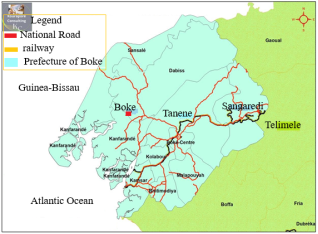
Figure 1. Map of Boke.
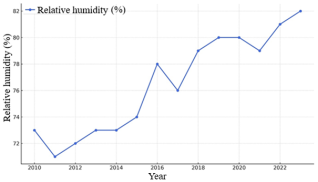
Figure 2. Interannual variation in relative humidity (%) in Boke between 2010 and 2022.
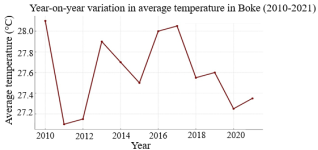
Figure 3. Interannual variation in average temperature (°C) in Boke between 2010 and 2021.
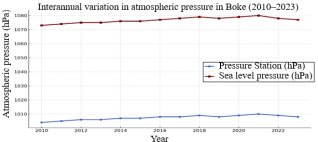
Figure 4. Interannual variation in atmospheric pressure in Boke between 2010 and 2023.
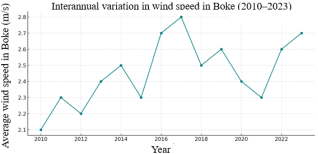
Figure 5. Illustrating the interannual variation in wind speed in Boke (2010–2023).




 Share This Article
 Twitter
 Linked In
 Facebook
 Copy
Copy Download